

Electric vehicles are no longer a niche purchase in British Columbia. You see them in condo parks, suburban driveways, and grocery store lots across Vancouver and the lower mainland. At some point, most EV owners hit the same conclusion: public charging is useful, but home charging is what makes daily life easy.
That’s where a lot of questions start.
What kind of charger do you need? Can your electrical panel handle it? Do you need permits? What does it cost? And maybe the biggest one, can any electrician do the work, or does this need a specialist?
If you’re planning an EV charger installation at home, here’s what actually matters.
Why more homeowners are installing EV chargers
The appeal is pretty simple. Charging at home saves time, cuts down on trips to public stations, and makes EV ownership feel much more practical. For most people, the best routine is plugging in overnight and starting the next day with a charged battery.
There’s also a property value angle. A home with a properly installed charger, or at least the wiring ready for one, can be more appealing to future buyers. That’s especially true in the greater Vancouver area, where EV adoption is already strong and still growing.
I think homeowners sometimes underestimate how quickly charging becomes part of the routine. At first it feels like an upgrade. Then it just feels normal, the way having a garage opener or reliable internet feels normal.
The main types of home EV chargers
Not all chargers are the same, and this is usually the first place where people get confused.
Level 1 charging
Level 1 uses a standard 120-volt outlet. In some cases, your vehicle may come with a portable charger that plugs right into it.
This is the simplest option, but it’s also the slowest. For drivers with short daily commutes, it may be enough. For many households, it gets old fast. If you drive often, share one charger between two EVs, or simply want more flexibility, Level 1 can feel limiting.
Level 2 charging
Level 2 chargers use 240 volts, similar to what powers a dryer or range. This is the setup most homeowners want.
A Level 2 charger can charge your vehicle much faster than a standard outlet. Exact charging speed depends on the charger, the vehicle, and your home’s electrical capacity, but the difference is noticeable. For most homeowners, this is the sweet spot between convenience and cost.
When people talk about home EV charger installation, they usually mean a Level 2 charger.
Smart chargers vs. basic chargers
Some chargers come with Wi-Fi, app controls, scheduling, energy tracking, and load management features. Others are more straightforward.
A smart charger can be worth it if you want to track electricity use, schedule charging during lower-rate periods, or manage charging in a home with limited panel capacity. A basic unit can work perfectly well if you just want reliable charging without extra features.
There isn’t one right answer here. It depends on how much control you want and how your home is set up.
What your home needs before installation
This is where professional advice matters. A charger is not just another plug. It adds a significant electrical load, and the installation has to match your home’s capacity.
Electrical panel capacity
Your panel needs enough available capacity to support the charger safely. Many newer homes can handle this without major changes. Older homes may need wiring upgrades or a panel upgrade before the charger can be installed.
This is common in older residential electrical systems across Vancouver and nearby communities. A homeowner may assume the charger is the only job, then find out the real issue is the panel.
That sounds annoying, and honestly, sometimes it is. But it’s much better to find that out early than after circuits start tripping or the installation stalls halfway through.
Dedicated circuit
An EV charger typically needs its own dedicated circuit. That means it isn’t sharing power with other appliances or outlets. This helps protect the system and keeps the charger operating the way it should.
Charger location
Placement matters more than people expect. The charger should be installed where the cable can comfortably reach the vehicle without creating a mess or a tripping hazard. Garage wall, carport, side wall, or exterior installation all have different wiring and protection needs.
For outdoor setups, weather protection is part of the equation too.
Permits and code compliance
In BC, electrical work like this generally requires proper permitting and code-compliant installation. A licensed electrician will know what applies to your property and local authority.
This part is not glamorous, but it matters. A neat-looking install is not the same as a safe, legal one.
How much EV charger installation costs
Homeowners usually want a simple number, but the truth is that pricing depends on the house.
A straightforward EV charger installation can be fairly manageable if:
- your panel has enough capacity
- the charger is going close to the panel
- wiring access is easy
- no major upgrades are needed
Costs go up when the project involves:
- a long wire run
- finished walls or ceilings that make access harder
- panel upgrades
- service upgrades
- trenching or detached garage work
- load management equipment
- condo or strata requirements
The charger unit itself is another part of the budget. Some homeowners buy the charger separately, while others want a contractor to supply and install it.
The smartest move is getting a site-specific estimate. In electrical services, guesswork is usually what gets expensive.
Are there rebates for home EV charger installation?
Rebates can help offset part of the cost, but they change over time. In BC, homeowners should check current provincial, utility, or municipal programs before moving ahead.
A qualified contractor can often point you in the right direction, but you should still confirm the latest program requirements yourself. Rebate programs may have rules about approved equipment, proof of installation, permits, or who completes the work.
If you’re in the lower mainland, it’s worth checking this early. Some people wait until the project is done and then realize they missed a document or eligibility detail.
Why professional installation matters
This is the part where saving money can backfire.
An EV charger puts sustained demand on your electrical system. If the circuit sizing is wrong, the panel is overloaded, or the wiring is poorly done, you are not just dealing with inconvenience. You are dealing with a real safety issue.
A proper installation should account for:
- panel load calculations
- breaker sizing
- wire sizing
- grounding and bonding
- location conditions
- code requirements
- permit and inspection needs
Licensed electricians also know how to spot related issues that a homeowner might miss, especially in older homes. Sometimes a charger install reveals outdated wiring, insufficient service capacity, or a panel that was already overdue for replacement.
That’s why many people searching for EV charger installation end up needing broader residential electrical work too.
And if you own a mixed-use property, a home-based business, or a site with more complex power demands, it helps to work with a team that also handles commercial electrical and industrial electrical jobs. The standards are different, but the experience with heavier loads and safety planning can be a real advantage.
What the installation process usually looks like
Most projects follow a similar path.
1. Site assessment
The electrician reviews your panel, available capacity, charger location, and wiring route. This is when they identify whether you need panel changes or wiring upgrades.
2. Equipment selection
You decide whether you’re using a charger you already bought or want one supplied for the project. This is also the time to choose smart features, amperage, and mounting location.
3. Permit and scheduling
If permits are required, they should be handled before work begins.
4. Installation
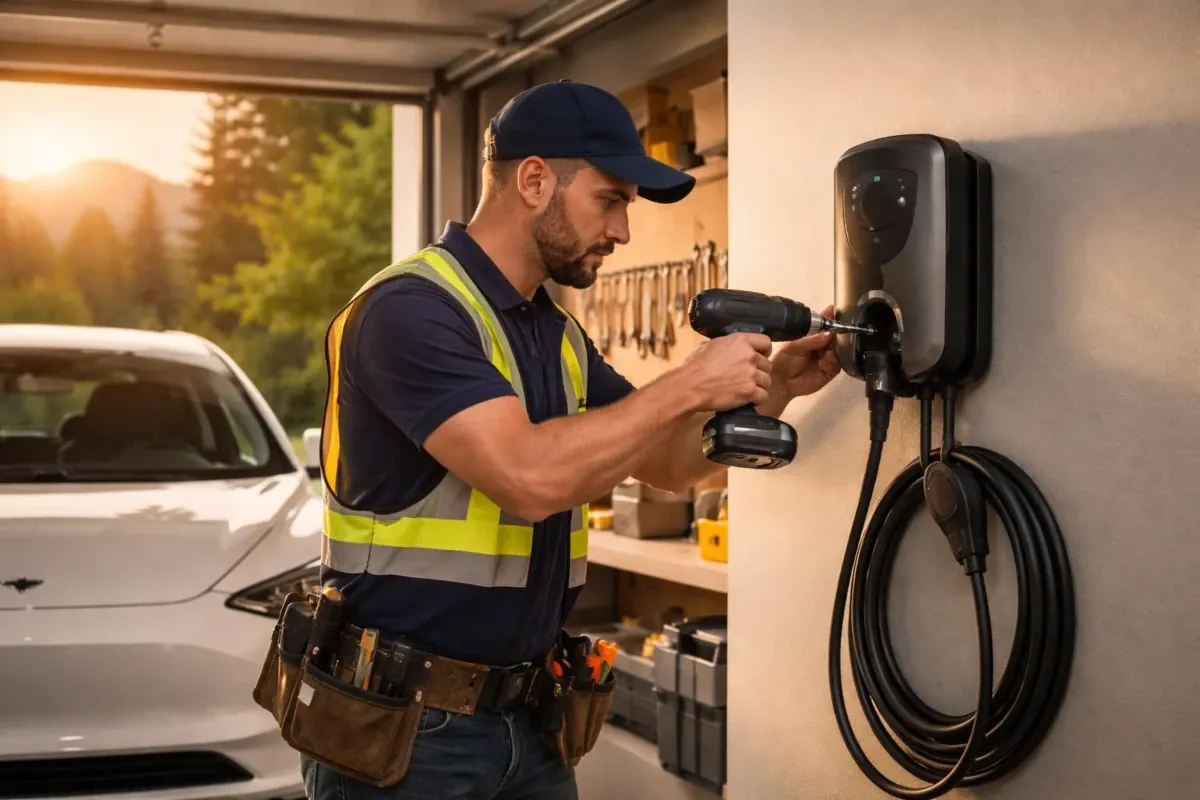
The electrician installs the dedicated circuit, mounts the charger, completes the wiring, and tests the system.
5. Final checks
The system should be tested for safe operation, and any required inspection should be completed.
A clean process feels boring, which is exactly what you want with electrical work.
How to choose the right electrician
If you’re comparing companies in Vancouver or the greater Vancouver area, ask direct questions.
Are they licensed electricians? Are they insured? Do they regularly handle EV charger installation? Can they assess panel capacity and complete wiring upgrades if needed? Will they pull permits when required? Do they explain the work clearly?
That last one matters more than people think. Good contractors don’t hide behind jargon. They tell you what your house can handle, what it can’t, and what the options are.
It can also be helpful to choose a company that provides a wider range of electrical services. If they already handle residential electrical, panel upgrades, troubleshooting, and even 24/7 emergency service, you’re less likely to be stuck calling around later if a separate issue comes up.
A home charger should make life easier, not more complicated
A well-planned EV charger installation gives you convenience every day. You plug in at home, charge safely, and stop thinking about it. That’s the goal.
The catch is that the charger has to fit the house, not just the vehicle. Panel capacity, circuit design, charger type, permits, and installation quality all matter. Skip those details, and a simple project turns frustrating fast.
For homeowners in Vancouver, the lower mainland, and across the greater Vancouver area, the best first step is a proper assessment by licensed electricians who understand EV charging and the home systems behind it. Good advice early on can save money, avoid delays, and make sure your charger works the way it should from day one.