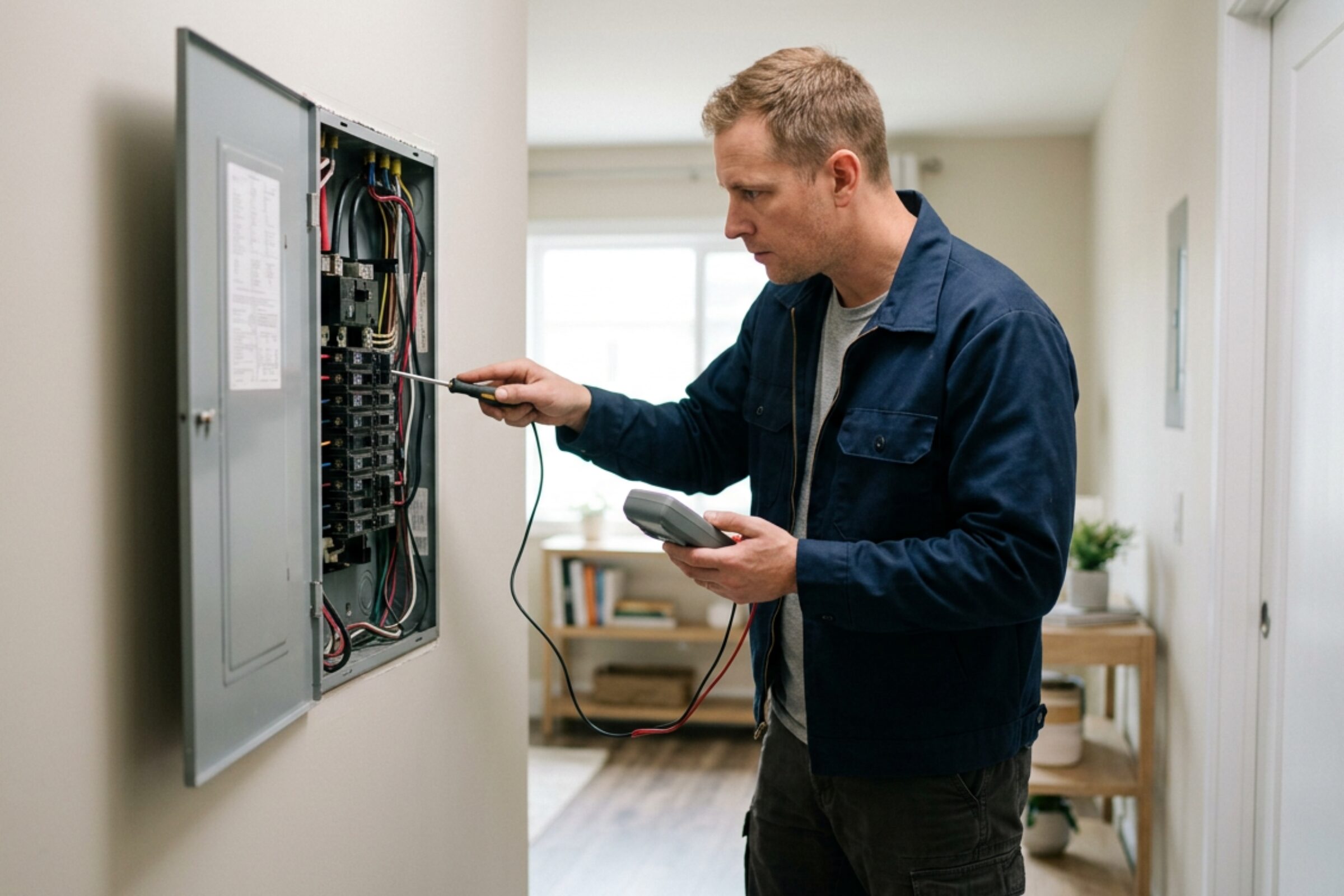

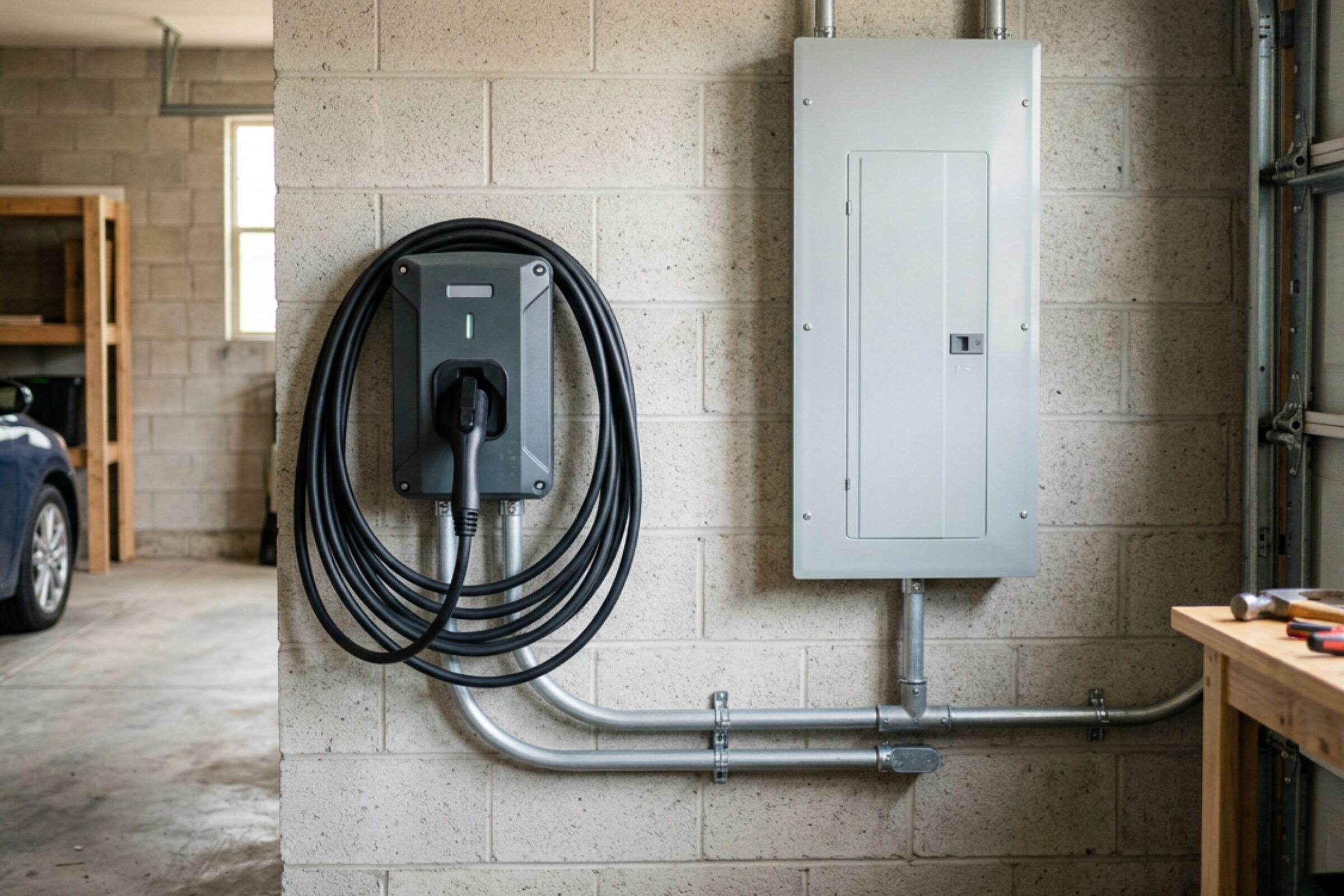

A home EV charger can sound straightforward until someone says you need a larger electrical panel. Suddenly, a practical purchase starts to look like a much bigger renovation.
But a panel upgrade is not automatically required for EV charger installation. Depending on your home, your driving habits, and the equipment selected, you may be able to charge safely using your existing electrical service.
BC Hydro’s homeowner education includes power-management devices as an alternative worth considering. These systems can control when an EV charges or how much electricity it draws, helping keep the home’s demand within approved limits.
That does not mean every home can avoid an upgrade. It means the decision should follow an electrical assessment, rather than an assumption that every EV needs maximum charging power.
Here is how to compare the options and understand what you are actually paying for.
Why an EV Charger Raises Questions About Capacity
Your home’s electrical service supplies a limited amount of power. Heating, cooking, clothes drying, and EV charging can all place substantial demands on that service.
An EV charger adds a load that may run for several hours. That makes it different from a small appliance used briefly throughout the day.
Still, adding up the numbers printed on your circuit breakers will not tell you whether your home can support charging. Those breakers protect individual circuits. Their combined ratings can exceed the service rating because the home is not expected to use every circuit at full capacity simultaneously.
Licensed electricians assess capacity using the applicable electrical code and accepted calculation methods. Where permitted, an assessment may also use suitable historical demand information.
Panel space and service capacity are different problems
A full panel may lack room for another breaker while the electrical service still has enough capacity for an EV charger. Depending on the equipment and installation, an approved panel arrangement or subpanel may address the space issue.
The reverse is also possible. A panel can have empty breaker spaces while the service lacks capacity for an unmanaged charging load.
A subpanel creates room for circuits. It does not increase the amount of electricity available to the property.
Before comparing quotes, ask which constraint needs to be solved: breaker space, service capacity, equipment condition, or a combination.
How EV Power Management Works
An EV energy-management system controls charging so that the installation stays within its approved electrical limits.
Instead of assuming the vehicle will charge at full power whenever it is plugged in, the system responds to available capacity. When household demand rises, it reduces or pauses charging. When demand falls, charging can increase or resume.
For example, an EV may charge overnight while most major appliances are off. If electric heating and other large loads create a higher demand, the management system adjusts the EV load according to its design.
There are two common approaches.
Pausing charging when demand is high
Some systems monitor electrical demand and disconnect the EV charging circuit when a set threshold is reached. Charging resumes once the required conditions are met.
The homeowner may notice little difference if the vehicle remains plugged in overnight. However, frequent interruptions can reduce the energy delivered during that charging window.
Adjusting the charging current
Other systems communicate with compatible charging equipment and vary the charging current as household demand changes.
This can allow charging to continue at a lower rate rather than stopping completely. Performance depends on the system, the vehicle, and the minimum current needed for charging.
Neither approach creates extra electrical capacity. Both manage when and how the EV uses the capacity already available.
Equipment must be approved for its intended use and installed in accordance with applicable requirements. A consumer smart plug or an ordinary charging schedule is not a substitute for an approved capacity-management system.
Start With Your Driving, Not the Charger’s Maximum Output
One of the most useful questions in residential electrical planning is also the simplest: how much energy do you need to replace each day?
A driver who travels modest distances and parks at home for 12 hours has different needs from someone who drives extensively and has only a short charging window.
As an illustration, suppose a vehicle averages 18 kilowatt-hours per 100 kilometers. Driving 50 kilometers uses about 9 kWh in the vehicle, before accounting for charging losses.
A nominal 240-volt charger operating at 16 amps supplies about 3.8 kW. Over eight uninterrupted hours, that is roughly 30 kWh before losses and any vehicle-related reductions. Actual results vary with temperature, vehicle settings, and battery conditions.
That example helps explain why the highest available charging rate is often unnecessary for daily use.
A 32-amp charger can replenish energy faster, but speed has value only if you need it. A smaller, properly designed charging circuit may meet your routine while placing less demand on the service.
The circuit must still be sized correctly for a sustained charging load. Charger output and breaker rating are not interchangeable numbers, so leave that selection to the electrician.
Four Options to Assess Before Upgrading the Service
There is no single lowest-cost solution for every home. The sensible approach is to compare options against the property’s capacity and your expected charging needs.
1. A lower-power Level 2 installation
Level 2 charging uses a 208- or 240-volt supply, depending on the building’s electrical system. Many detached homes use 240 volts.
A lower charging setting can reduce the calculated load and may make an installation feasible without increasing the service size.
However, an adjustable charger cannot simply be turned down informally and treated as a smaller permanent load. Its configuration must meet the applicable requirements, including any restrictions on who can change it.
2. An approved energy-management system
Power management may allow Level 2 charging where an unmanaged charger would otherwise create a capacity problem.
This option deserves a close look when the existing service is in good condition, household peak loads are intermittent, and the vehicle usually has a generous charging window.
The comparison should include the management equipment, installation labor, monitoring components, and any communication wiring or setup.
3. Approved sharing of available power
Some systems share available power between EV chargers or coordinate charging with another load. Two vehicles, for instance, may share a defined charging allocation instead of each receiving maximum power simultaneously.
Compatibility matters. Do not assume a splitter, adapter, or switching device is suitable merely because its connectors fit. The equipment and arrangement need to be approved for the intended installation.
4. Level 1 charging for lighter use
Charging from a suitable 120-volt circuit may be enough for some low-mileage drivers. It is slower, and cold-weather conditions can leave less energy available for battery charging.
The outlet, circuit, and charging equipment still need to be appropriate for sustained use. Have an electrician assess them rather than relying on an unfamiliar garage receptacle.
Extension cords and improvised adapters are not a sensible workaround. Follow the vehicle and charging-equipment manufacturers’ instructions.
When a Panel or Service Upgrade Makes Sense
Avoiding an upgrade is useful only if the alternative safely meets your needs.
An upgrade may be appropriate when the existing service cannot support the expected loads, even with a suitable management strategy. It may also be necessary when electrical equipment is damaged, unsuitable, or no longer serviceable.
Future plans matter here. A home preparing for electric heating, an electric water heater, and multiple EVs needs a broader assessment than a home adding one modest charging load.
Consider two households. One has a single EV, a short commute, and long overnight parking. Another has two high-mileage EVs, electric heating, and limited charging time. The same recommendation would not necessarily serve both households well.
Ask for a whole-home view before paying for major work. That can help avoid installing an interim solution that needs to be replaced soon afterward.
Also clarify what “upgrade” means in the estimate. Replacing a panel, increasing service capacity, and modifying utility connection equipment are different scopes of work. A new panel alone does not necessarily provide a larger service.
Why Installation Costs Vary Across the Lower Mainland
The charger is only one part of the installed cost.
In Vancouver and throughout the greater Vancouver area, the route between the electrical equipment and the parking space can have a major effect on the project. A short, accessible route to an attached garage is different from trenching to a detached garage or running conduit through finished areas.
Other cost factors include panel compatibility, cable length, mounting conditions, permit requirements, and the need for repairs or wiring upgrades.
Power management adds equipment and installation work. In some homes, that cost is lower than increasing service capacity. In others, the difference is smaller, particularly if substantial electrical work is needed anyway.
Be cautious with universal claims about savings. A useful comparison is between complete installed scopes that meet the same charging need.
A lower quote that excludes trenching, permits, or required electrical repairs may not be cheaper in the end.
What to Ask During an Electrical Assessment
A useful assessment should explain the recommendation in terms you can understand. You do not need to perform the load calculation yourself, but you should know what it means for your options.
These questions can keep the discussion focused:
-
Is the limitation service capacity, panel space, equipment condition, or something else?
-
What charging rate would meet my usual driving needs?
-
Would approved power management or a lower charging rate avoid a service upgrade?
-
Which future household loads have been included in the assessment?
-
Does the estimate include permits, required inspections, and all related electrical work?
-
What happens if the management system loses communication or stops working?
That last question matters. Ask how the proposed system responds to a fault and whether normal operation depends on internet access, subscriptions, or a particular equipment pairing.
A charger’s app can be convenient, but convenience features and electrical safety functions are different things. The installer should be able to explain that distinction clearly.
Condos and Shared Parking Need a Different Assessment
A detached-home solution does not automatically translate to a condo or shared parkade.
In a strata building, charging may involve shared electrical capacity, common property, parking rights, billing, and approval processes. A building-wide charging plan can be more practical than separate installations designed without reference to one another.
Load sharing can help distribute an available power allocation among several vehicles. However, that allocation still has to come from an assessed building supply.
Residents should speak with their strata before buying equipment. The proposed charger may need to work with a building’s existing or planned management system.
Commercial electrical experience can be relevant in larger shared buildings, where distribution equipment and parking infrastructure differ from a typical house. The important factor is experience with the specific installation, not simply familiarity with wall-mounted chargers.
Plan for Reliable Charging, Not the Biggest Number
The best home charging setup is one that reliably replaces the energy you use, fits your property, and meets electrical requirements.
For many homeowners, that may be a lower-power charger or an approved power-management system connected to the existing service. For others, a service upgrade is the more practical long-term choice.
Start with your driving pattern. Have the existing electrical system assessed. Then compare complete options, including how each one will perform during busy household periods.
Hearing “panel upgrade” should begin a discussion about capacity, condition, and alternatives. It should not end the conversation before those questions have been answered.