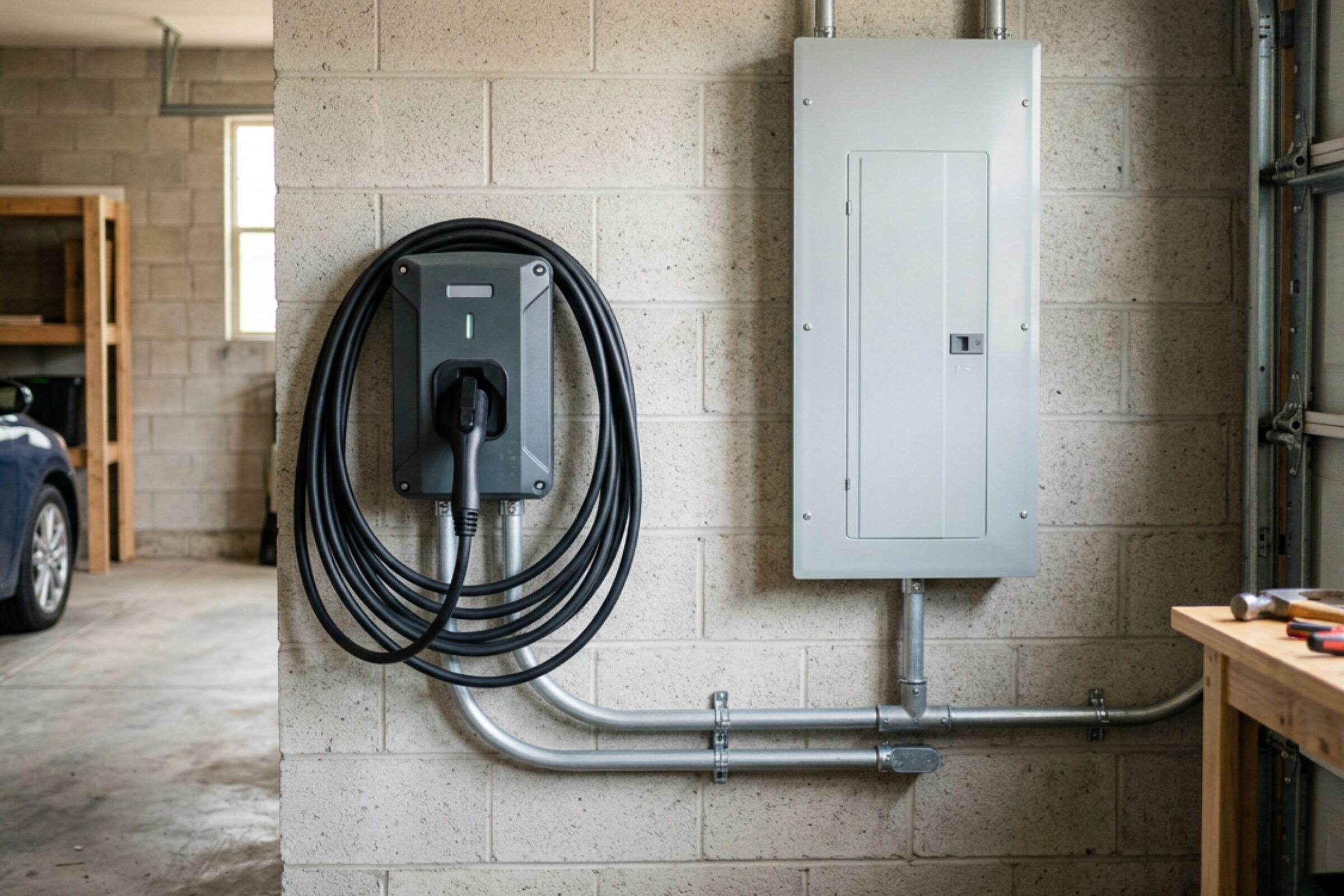



A 100-amp electrical service can support a Level 2 EV charger in some homes. In others, the same installation would push demand too close to the service limit. The number printed on the panel is a starting point, not an answer.
That distinction matters if you are planning an EV charger installation alongside a heat pump, a hot tub, or a future suite. A service upgrade can be expensive and may involve utility work. Skipping one when it is needed is not safe. The sensible first step is a professional load calculation that accounts for the charger and the rest of the home.
For homeowners in Vancouver and elsewhere in British Columbia, there are two ways a contractor may assess existing demand: a traditional calculated-load method or, where permitted and enough history is available, a method using 12 months of meter data. Understanding what each method can tell you makes it easier to discuss the options before committing to wiring or service changes.
What does “100 amps” tell you?
A 100-amp service describes the rated capacity of the electrical supply to the home. It does not mean the house constantly uses 100 amps. Demand rises and falls as equipment switches on and off. An electric oven, clothes dryer, heating system, and EV charger might all draw power, but they will not necessarily operate together at full output.
The rating also does not tell you whether the panel has an open breaker space, whether its components are suitable for the proposed work, or whether the route to the parking space can accommodate a new circuit. Those are separate installation questions.
An EV charger’s setting makes a substantial difference. At 240 volts, a charger drawing 32 amps uses about 7.7 kilowatts while charging. One drawing 40 amps uses about 9.6 kilowatts. EV charging is generally treated as a continuous load, so the circuit and equipment must be sized accordingly. For example, a 32-amp charging setting commonly calls for a 40-amp circuit, subject to the equipment instructions and applicable electrical rules.
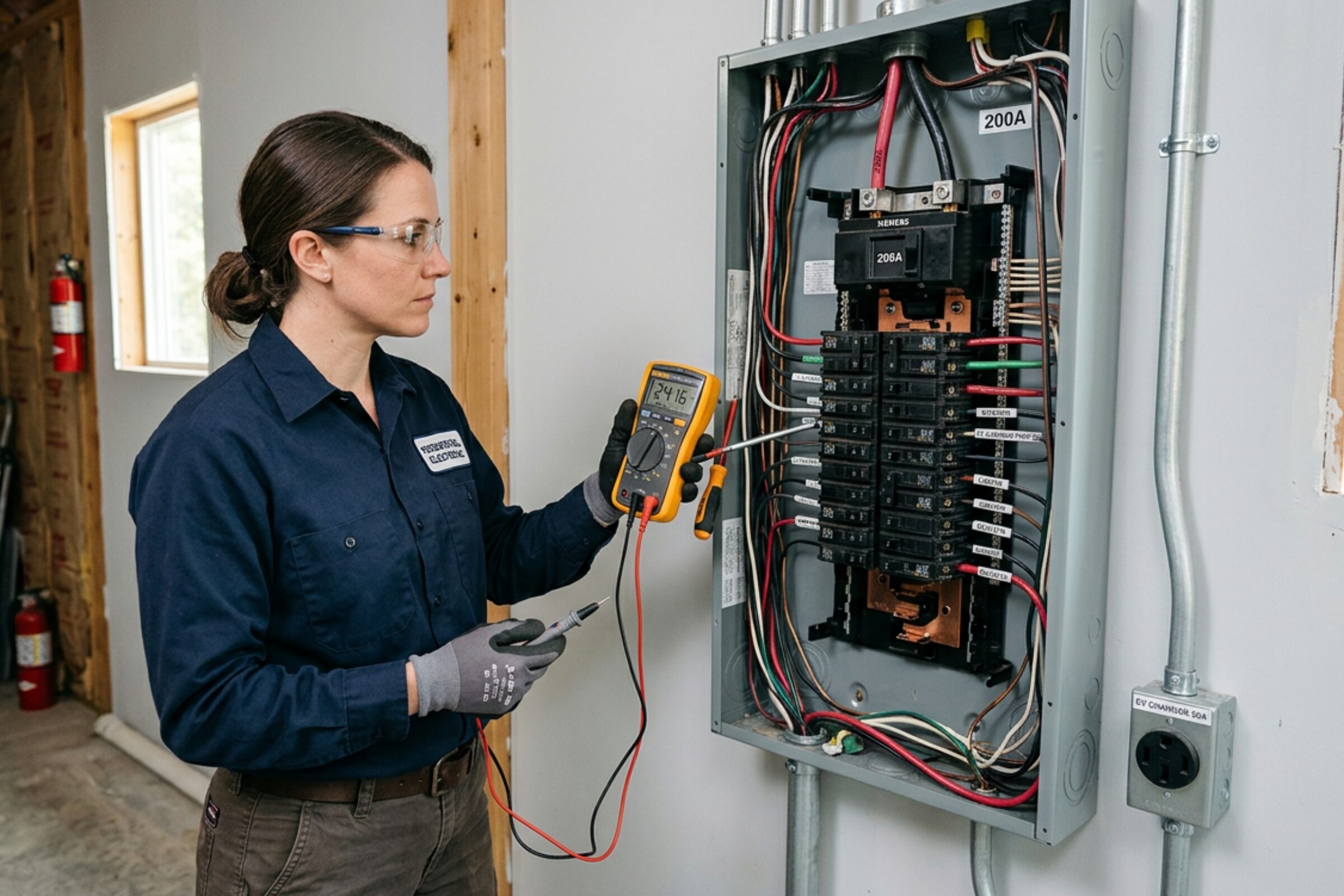
A qualified electrical contractor has to consider that new load alongside the home’s existing loads. The answer may be that a 100-amp service has room, that charging must be managed, or that more service capacity is warranted.
Two ways to assess the home’s electrical demand
The traditional calculated-load method
The traditional method uses an electrical-code calculation based on the home and its equipment. Floor area and specified loads are entered into a standardized formula to estimate demand. The contractor then adds the proposed equipment and compares the result with the service capacity.
This method is especially useful for a newly built home or one without a full year of electricity records. It also gives a consistent way to assess planned equipment that has not yet been installed.
Its limitation is that a standardized calculation does not always describe how a particular household uses electricity. Two houses with similar floor plans can have different heating systems, appliances, and habits. A formula is still a valid way to assess capacity, but it may be more conservative than a calculation informed by actual usage.
The meter-data method
Meter data looks at how much electricity the home used during intervals over the previous 12 months. The history helps the contractor identify periods of high demand, including seasonal changes that a few recent bills might miss.
Technical Safety BC has approved a meter-data approach since 2023. It must be applied using the approved formula and the requirements of the authority responsible for the permit. Some municipalities administer their own electrical permits, so the contractor needs to confirm which method applies to the property.
Hourly data is useful, but an hourly reading is not a direct measurement of every momentary peak. It records energy used across an hour. A contractor must apply the required calculation rather than simply take the largest number in a spreadsheet and call it the home’s peak amperage.
Meter history has another firm limit: it cannot describe a load that was not present during the recorded year. If you plan to add a heat pump, suite, or hot tub, those proposed loads still need to be considered. Likewise, a newly constructed home or a household without 12 months of usable history will generally need the traditional calculated-load method.
How to get your hourly meter data
The utility normally provides account data to the account holder, not directly to an electrical contractor. If your contractor asks for meter history, you can usually export it through your online utility account. Menu names vary by provider, but the process is generally:
-
Sign in to your utility account, or create an online profile.
-
Open the data export center or usage-data section.
-
Choose consumption history as the export type.
-
Set the date range to the previous 12 months.
-
Select hourly intervals.
-
Choose Export data.
-
Watch for an email saying the file is ready, often within 24 hours, then download it and send it to your contractor.
A monthly bill total is not a substitute. It tells you how much energy you used over a billing period, not how much was used during the busiest hours. If the hourly export is unavailable or the home lacks a full year of suitable data, ask the contractor to use the traditional method.
Turning a load assessment into an installation decision
Once the contractor has the required information, they can calculate demand under the applicable Technical Safety BC or municipal rules, account for the proposed charger, and compare the result with the existing service rating. The calculation also supports the electrical permit application.
The outcome usually falls into one of three broad categories. There may be enough capacity for the intended charger setting without changing the service. Capacity may be tight, in which case a lower charging setting or an approved load-management device could be appropriate. Or the calculated demand may exceed what the existing service can support, making a service upgrade worth evaluating.
It is tempting to look at an hourly meter reading, convert kilowatt-hours to amps, subtract that figure from 100, and treat the remainder as available charging capacity. That is too simple for an installation decision. The conversion depends on the measurement interval and electrical assumptions, and the permitted calculation may require adjustments. Breaker, conductor, panel, and equipment ratings matter too.
A useful question for your contractor is: “What charger output can this home support under the applicable calculation?” That gets closer to the practical decision than asking only whether a charger can be installed.
Include the projects you have already planned
A calculation for today’s home can become outdated quickly if you already intend to add major loads. Tell the contractor about a planned heat pump, electric water heater, expanded kitchen, home addition, secondary suite, pool, or hot tub. You do not need to predict every future appliance, but a known renovation belongs in the discussion.
Consider a household that wants a charger now and a heat pump next year. Installing the fastest charger the current calculation allows may leave little room for the heat pump. A lower charging setting or managed charger might meet the household’s driving needs while preserving flexibility. That is a more useful conversation to have before the charger circuit is installed.
What if the 100-amp service is near its limit?
Limited capacity does not automatically mean a utility service upgrade. The options depend on the calculation, the existing equipment, and what the household needs the charger to do.
Adjust the charging load
A Level 2 charger does not have to run at its maximum possible output. A contractor may be able to install or configure equipment for a lower current, provided the settings and installation comply with the equipment instructions and electrical requirements.
Charging time will increase. For a car parked at home overnight, that may be an acceptable trade-off; for a vehicle with high daily mileage and a short parking window, it may not be. Start with how much energy the car typically needs to regain, not the largest charger advertised for it.
Use approved EV load management
An EV power management device monitors electrical demand and adjusts or pauses vehicle charging when the home needs more power elsewhere. Charging resumes or increases when capacity is available. This can let a household use its existing service without assuming that the charger and every major appliance can draw full power at the same time.
The device must be appropriate for the installation and accepted under the applicable electrical requirements. Its operation also needs to suit the driver: charging that pauses during busy evening hours may be fine if the vehicle remains plugged in overnight.
Some utility programs offer rebates for eligible equipment or installations. Program terms can change, so check current eligibility before treating a rebate as part of the project budget.
Other approved power-management devices can coordinate two end uses that share available circuit capacity. That does not mean two large appliances can simply be connected to one circuit. The equipment and wiring must be designed and installed for that arrangement.
Can efficiency improvements free up capacity?
Sometimes, but the type of improvement matters.
Disconnecting an unused second freezer or removing electric baseboard heaters that have been properly replaced can reduce the loads the home must support. If equipment is no longer needed, tell the contractor so they can determine how its removal affects the calculation. Simply promising not to use an installed appliance may not change the permitted load assessment.
Insulation, better windows, and tighter doors can reduce heating and cooling energy use. They may also make a smaller heating or cooling system practical during a renovation. That is good for operating costs, but lower annual electricity consumption does not automatically create a specific number of amps for an EV charger. The contractor still needs to assess the equipment that remains installed and the applicable calculation. Qualifying building-efficiency work may have rebates available.
Replacing an older water heater, dryer, or other appliance can help when the replacement has a lower electrical demand. Check its rated load rather than assuming a newer model uses fewer amps at its peak. An efficient appliance can save energy over the year while drawing a similar amount of power when it runs.
Reducing waste is worthwhile regardless of the charger decision. It lowers consumption, but for service capacity, the key question is what demand the electrical installation must safely accommodate.
When is an upgrade the right choice?
If the approved load calculation shows that the existing service cannot support the planned equipment, and load management or other practical changes do not solve the problem, a service upgrade may be necessary. A contractor can size it around both current demand and credible future plans.
A move from 100 amps to 200 amps may be enough for some homes. Larger options, such as 320- or 400-amp service, should be supported by a calculation rather than chosen “just in case.” Oversizing adds cost without necessarily giving the homeowner a benefit.
It also helps to distinguish a panel replacement from a service upgrade. A new panel can address equipment condition or provide room for circuits, but replacing a 100-amp panel does not by itself increase the capacity supplied to the home. Increasing service capacity may require changes to service conductors, metering, utility connections, and other equipment. Permits and utility coordination can add time to the project.
Start with the calculation, not the upgrade quote
For a home with 100-amp service, the practical sequence is straightforward: have a qualified electrical contractor assess the existing installation, provide 12 months of hourly meter data if available, and identify both the proposed charger output and other major planned loads. The contractor can then apply the method accepted by the permitting authority and explain the result.
If there is room, the EV charger installation can proceed through the required permitting and electrical work. If capacity is limited, compare a lower charging setting and approved load management with the cost and usefulness of an upgrade. If demand justifies more service capacity, size the upgrade to the home’s actual plans.
A 100-amp label does not decide the issue. The home’s demand, the charger you intend to use, and the loads you plan to add do.