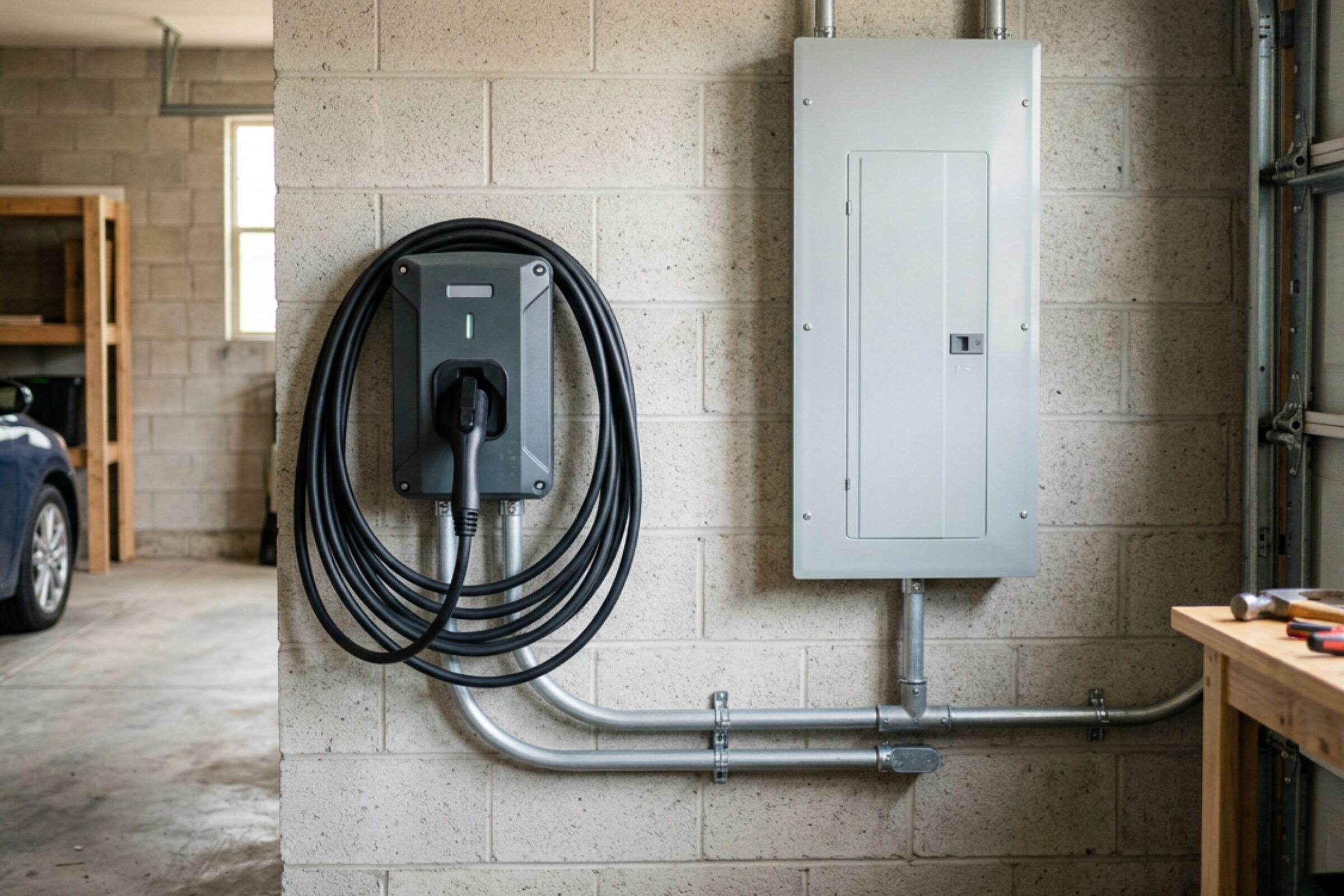

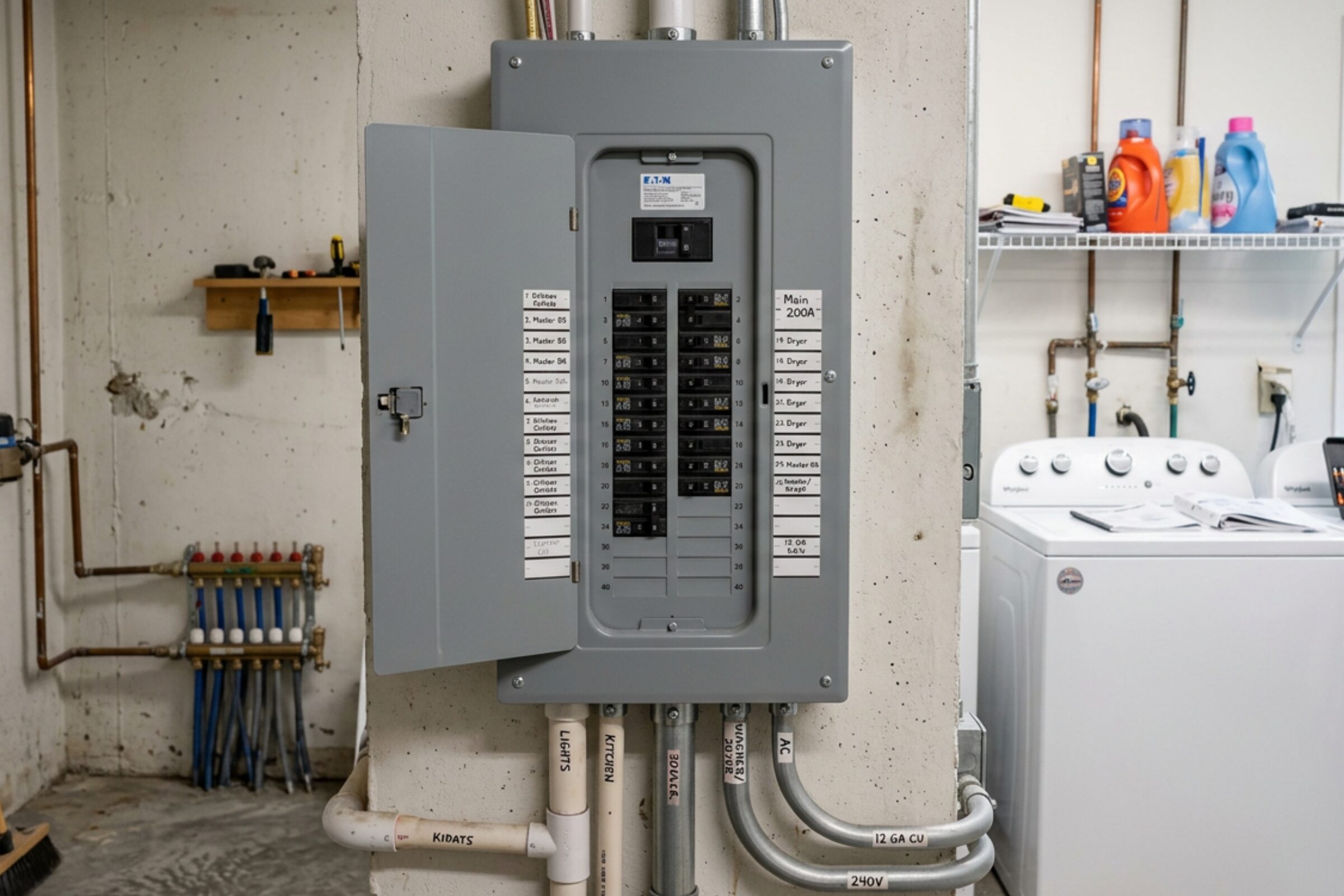

A new electrical panel can look like a straightforward purchase: choose an amp rating, count the breaker spaces, and pick a familiar brand. That approach misses the decision that affects nearly everything else. The panel family determines which breakers and accessories can be used, how the equipment can be configured, and how easy it may be to maintain years later.
For a Canadian homeowner planning a renovation, service upgrade, or EV charger installation, the useful question is not “Which brand is best?” It is “Which approved panel platform fits this installation and the work the home may need later?”
Start With the Panel’s Job
An electrical panel distributes power from a service or feeder to branch circuits. Those circuits supply lighting, receptacles, cooking equipment, heating and cooling systems, and other loads. In residential work, the equipment is often called a load center. Commercial drawings may use terms such as panelboard or distribution panel. The terms overlap, though the equipment and its applications can differ.
Inside the enclosure are bus bars, places for branch breakers, and provisions for neutral and grounding conductors. Depending on the model, the panel may have an integral main breaker or main lugs, along with options for grounding bars, surge protection, or other accessories.
Before comparing brands, establish where the panel sits in the electrical system. Is it the home’s main service equipment? Is it a downstream subpanel serving a garage or finished basement? Is it dedicated to a group of loads in a workshop? That answer affects the disconnecting arrangement, bonding, feeder design, and equipment selection.
Main breaker or main lugs?
A main-breaker panel has an integral breaker that can disconnect power to the circuits it supplies. A main-lug panel has lugs for the incoming conductors but no integral main breaker; it is commonly supplied by an upstream breaker or disconnect.
Neither configuration is automatically better. A main-lug panel may suit a subpanel when the required upstream protection and disconnecting means are already in place. Main service equipment has its own requirements. The panel’s role, location, markings, and applicable rules must all agree.
Size for the Load, Then Leave Room to Work
A panel’s amp rating and its number of breaker spaces answer different questions. The rating is part of the electrical capacity design. Spaces determine how many branch breakers the panel can accommodate, subject to its labeling and the approved breaker types.
Residential service ratings commonly include 100 A, 125 A, 150 A, and 200 A. None is a reliable choice based on house size alone. Heating method, cooking equipment, air conditioning, an EV charger, and other major loads all matter. A load calculation, along with conductor sizing and overcurrent protection review, is the starting point for a service or feeder decision.
Space planning deserves the same attention. Imagine a home with a panel that has adequate electrical capacity for a proposed project but only one unused breaker space. Adding an EV charger, a heat pump, and circuits for a basement renovation could become awkward or require another panel. Conversely, a panel full of empty spaces does not mean the service can support every load someone might add.
Many contractors aim to leave roughly 20 to 30 percent of the spaces unused when the budget and wall area allow. That is a planning guideline, not a universal code requirement or a substitute for a load calculation. Also check the panel label before assuming tandem or duplex breakers can create more room. Their use is limited to the configurations and positions approved for that specific panel.
It helps to describe plausible future work before choosing a panel: EV charging, electric heating, a hot tub, a workshop, a secondary suite, or whole-home surge protection. You do not have to build for every hypothetical appliance. You do want to avoid buying a panel that is already cramped on installation day.
Choose the Enclosure for Its Location
Panel configuration is partly about the wall and the environment around it. Flush-mount panels are commonly used in finished interior walls, where the enclosure sits within the wall cavity. Surface-mount panels are often more practical in unfinished basements, utility rooms, garages, and commercial service areas.
The electrician also needs a workable route for conductors. A panel that fits between studs may still be a poor choice if cable entries are crowded or the intended top or bottom feed is difficult to arrange. Adequate working space in front of the equipment matters too.
Outdoor equipment needs an enclosure approved for its exposure and application. A weather-exposed meter-main combination or panel at a detached structure cannot be selected as though it were going in a dry mechanical room. Even a suitable enclosure needs careful installation to keep water out and allow future service.
For detached garages and other outbuildings, a subpanel may shorten branch-circuit runs and make later additions simpler. Its feeder, grounding, bonding, and disconnecting arrangement still need to be designed for the particular installation.
Compare Brands by Platform, Not Logo
Eaton, Schneider Electric and Square D, Siemens, ABB and GE ReliaHome, and Leviton are among the names a Canadian buyer may encounter. They are worth comparing, but a brand name alone does not identify a compatible breaker or accessory. Each manufacturer can have multiple product families, generations, and configurations.
Eaton may be a practical candidate where an existing installation already uses a supported Eaton platform and matching parts are easy to obtain. Schneider Electric and Square D are familiar choices in residential and commercial distribution, but related product lines should not be treated as interchangeable. Siemens may appeal to someone maintaining consistency with an installed Siemens system. ABB and GE ReliaHome, as well as Leviton, are other options to assess against the project’s ratings, available accessories, and local supply.
The best comparison is specific. Once the electrician has identified suitable panel models, ask:
-
Are the required branch breakers, main breakers, and specialty devices approved for this exact panel?
-
Are AFCI, GFCI, surge-protection, and other needed accessories available?
-
Can replacement breakers, filler plates, trims, and grounding kits be obtained locally?
-
Does the enclosure provide enough spaces and suitable mounting and feed options?
-
Will the platform remain reasonably serviceable if a breaker needs replacing later?
Availability is easy to dismiss until a repair is delayed by a hard-to-find part. For homeowners in Vancouver or elsewhere in the Lower Mainland, local stock can be a sensible consideration alongside the equipment’s technical suitability.
Breaker Fit Is Not Breaker Approval
A breaker may slide into a panel and appear to seat properly while still being the wrong device for it. Physical fit does not establish that the breaker has the required approval for that panel. The contact with the bus, retention, ratings, and other details matter.
Use the panel labeling and applicable manufacturer documentation to identify approved breaker types, then confirm that the selection meets Canadian electrical and inspection requirements. Do not assume that two breaker families are interchangeable because they share a manufacturer, have similar names, or look identical from the front.
This matters during small repairs as much as during a full installation. If a breaker trips repeatedly or has failed, the answer is not to grab whichever replacement fits on the bus. The circuit and equipment should be assessed, and any replacement must be suitable for the panel.
Treat Older Equipment as an Assessment, Not a Parts Hunt
An older panel does not automatically need replacement. But age can change the economics and safety of a repair, particularly when breakers or accessories are difficult to find.
Federal Pioneer and other legacy equipment may call for a closer look at the exact model, condition, breaker availability, and support for the proposed work. An obsolete line, damaged bus stabs, signs of overheating, or limited parts supply can make a full panel replacement more sensible than adding circuits or changing individual breakers. Swapping a breaker will not repair a damaged bus connection.
A major renovation or service upgrade is a natural time to make that assessment. If the existing panel is sound and well supported, keeping its platform may simplify maintenance. If it is cramped or poorly supported, choosing a current platform may avoid carrying those constraints into the next renovation.
What Good Installation Planning Looks Like
Panel selection and installation are connected. A roomy enclosure is less useful if conductor routing leaves the wiring crowded, circuit labels are vague, or accessories have no practical place to go.
In service equipment, neutral and bonding arrangements differ from those in downstream panels. Subpanels generally require isolated neutrals and appropriately bonded equipment-grounding conductors. The exact configuration must follow the equipment instructions and applicable Canadian code requirements; a bonding screw or strap in the wrong place is not a minor detail.
Terminations must be made to manufacturer torque specifications. The installer also needs to plan cable entries, gutter space, circuit identification, and room for any required AFCI or GFCI breakers and surge-protection equipment. On larger or mixed-load projects, circuit distribution should be considered for balance and serviceability.
These are reasons to have a qualified electrician design and install the equipment, rather than treating panel replacement as a simple box swap. In British Columbia, the applicable Canadian Electrical Code requirements, equipment approvals, and local inspection process all belong in the plan.
A Practical Decision Order
If you are gathering information before speaking with an electrician, start with what the panel must do rather than a preferred brand. Identify whether it will be main service equipment or a subpanel, what loads it must supply now, and what additions are reasonably likely. Note its location and whether the installation calls for flush, surface, or outdoor-rated equipment.
The electrician can then perform the load calculation and confirm voltage, phase, feeder or service design, ratings, fault-current considerations where applicable, and required disconnecting means. With those requirements established, it becomes possible to compare approved panel families, breaker ecosystems, available spaces, and local parts supply.
That order prevents a common mistake: buying breakers or accessories first, then trying to find a panel that will accept them. Select the panel platform as a system.
Common Questions About Electrical Panels
Can I use another brand of breaker if it fits?
Do not rely on fit. Check the panel label and applicable manufacturer documentation for approved breaker types, and follow the relevant Canadian approval and inspection requirements. A breaker that appears to snap in place may still be unsuitable.
How many spare spaces should a new panel have?
There is no single number that fits every home. Roughly 20 to 30 percent spare space can be a useful planning target when practical, especially if EV charging, a heat pump, or a basement renovation is likely. Spare spaces do not replace a load calculation.
Does a 200 A panel mean I have a 200 A service?
No. A panel rating does not, by itself, establish the capacity of the service or feeder supplying it. The complete installation, including conductors and overcurrent protection, determines what can be supplied.
When is replacement better than adding a subpanel?
That depends on the existing equipment and the planned loads. A subpanel can be useful when the main panel is sound and the feeder and service can support the work. Replacement may be preferable if the current panel is damaged, obsolete, difficult to maintain, or part of a broader service upgrade.
A good panel choice should make the next repair or addition less complicated, not merely get today’s circuits connected. The brand matters, but the exact approved platform, its condition, its available parts, and the home’s calculated needs matter more.