
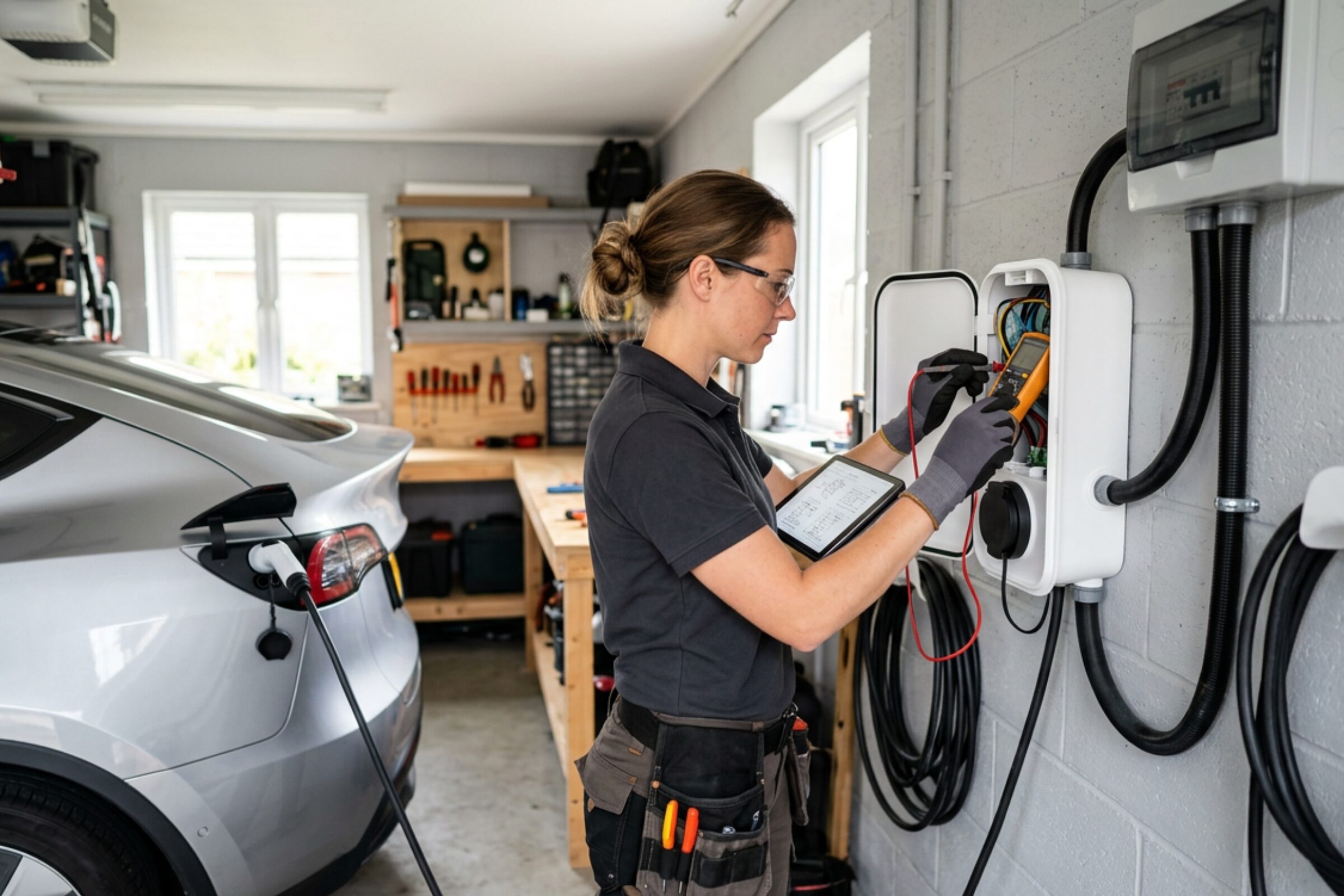

Buying an electric vehicle often leads to a second question: Will the house need an electrical upgrade?
Sometimes it will. Often, there are other options worth checking first.
An EV charger adds a substantial load, but that does not automatically mean replacing a panel or increasing the electrical service. Your daily driving, charging schedule, existing household demand, and choice of equipment all affect the answer. A properly configured load-management system may also make charging possible without a service upgrade.
For homeowners planning EV charger installation in Vancouver or elsewhere in the Lower Mainland, the best starting point is a capacity assessment, not an assumption that the fastest charger is necessary.
Start With How Much Energy You Actually Need
The useful question is how much energy you need to replace before your next drive.
Consider an EV that uses about 18 kilowatt-hours (kWh) per 100 kilometers. A 40-kilometer daily commute would consume approximately 7.2 kWh. Charging requires somewhat more electricity because some energy is lost during the process, but this is still a much smaller task than replenishing an empty battery.
A driver who parks at home for 12 hours each night has different requirements from someone who drives 180 kilometers daily and returns home between shifts.
Think about your usual driving rather than your longest annual road trip. Public fast charging can cover occasional unusual needs, although its availability and cost should factor into your decision.
Battery size alone is not a reason to install a high-amperage charger. A large battery used for short daily trips may need relatively little overnight charging.
Understand What Each Charging Level Can Do
Charging speed depends on the equipment, the vehicle’s limits, and operating conditions. Battery temperature and state of charge matter especially during DC fast charging.
The following examples use an energy consumption rate of 18 kWh per 100 kilometers. They are estimates, not guaranteed charging times.
Level 1: A Standard 120-Volt Connection
Level 1 charging usually supplies roughly 1 to 1.5 kilowatts (kW) through a suitable 120-volt receptacle.
At that power, replacing 18 kWh takes roughly 12 to 18 hours before accounting for charging losses. Actual charging can take longer, especially in cold weather when the vehicle also needs energy to warm the battery.
That sounds slow, but Level 1 can be practical for modest daily driving. If your car spends most nights parked at home, it may replace enough energy without a new 240-volt circuit.
The receptacle and circuit still need to be suitable for sustained charging. An electrician should assess their condition and other connected loads. Avoid extension cords, power strips, or improvised adapters.
Level 2: The Common Home-Charging Choice
Level 2 charging uses a 240-volt circuit. Equipment can supply approximately 3.3 to 19.2 kW, although the vehicle and electrical installation may limit usable power.
At 6.6 kW, delivering 18 kWh takes about 2.7 hours in ideal conditions. Allow more time for losses and vehicle-related limits.
Many households do not need the highest available output. For example, a 240-volt charger operating at 24 amps supplies approximately 5.8 kW. That can replenish a typical day’s driving comfortably during an overnight parking window.
Choosing a lower current can reduce the electrical capacity required and may simplify installation.
DC Fast Charging: Mainly for Public and Commercial Locations
Often called Level 3, DC fast charging supplies direct current to the battery. Many public chargers operate between 50 and 350 kW, though other power ratings exist.
At a constant 50 kW, transferring 18 kWh would take about 22 minutes before losses. At 350 kW, the mathematical minimum is about three minutes. Real sessions take longer because a vehicle rarely maintains its maximum charging rate throughout the session.
DC fast charging generally is not a practical residential option. Its electrical requirements and equipment costs are far beyond what most homes need.
Panel Rating Is Only Part of the Capacity Question
A label saying “100 amps” or “200 amps” does not tell the whole story.
An electrical service has a maximum capacity, but household appliances do not all draw their maximum current continuously. Heating equipment cycles. Ovens switch elements on and off. Dryers finish their loads.
The challenge is determining whether the proposed charging load can be added safely under applicable electrical rules.
An electrician will consider the service rating, existing demand, major appliances, panel condition, and proposed charger settings. Future plans matter too. A heat pump, electric water heater, or second EV could change the decision.
An empty breaker space does not prove that capacity is available. Conversely, a full panel does not necessarily mean the incoming service needs to be enlarged. Panel-space problems and service-capacity problems are related, but they are not the same thing.
Why Actual Electricity-Use Data Helps
Recent consumption records can make the assessment more useful. Where permitted by the applicable code and accepted by the authority having jurisdiction, historical demand data may support a capacity calculation.
A full year of suitable interval or demand data can capture seasonal differences, including winter heating loads. A monthly bill showing total kWh alone may not reveal the peak demand needed for this analysis.
Licensed electricians should determine which assessment method is appropriate. Historical data also needs context: last year’s usage will not include a heat pump installed last month.
Can Load Management Avoid a Service Upgrade?
In many homes, the issue is overlapping demand rather than constant demand.
Imagine a household running an electric range, dryer, and heating system shortly after everyone arrives home. Adding unrestricted EV charging during that period could create a capacity problem. Later that night, the same house may have substantial unused capacity.
An EV energy-management system can monitor electrical demand and reduce or pause charging when necessary. Charging resumes or increases when capacity becomes available.
This can make better use of the existing service without relying on someone to remember which appliances are running.
However, a basic charging schedule is not automatically equivalent to an approved load-management system. Scheduling charging for midnight may lower costs, but other appliances can still operate at midnight. The equipment and installation must provide the control required by the applicable electrical rules.
When comparing options, ask whether managed charging could support your actual daily needs. A slightly slower charge that finishes before morning may be a better investment than a larger service.
When an Electrical Upgrade Makes Sense
An upgrade may be appropriate when the existing service cannot support the required load and a compliant management solution is unsuitable or insufficient.
Other reasons can include damaged equipment, an unsuitable panel, or several planned electrification projects. Sometimes wiring upgrades are necessary even when the service itself has enough capacity.
The distinction matters:
-
A new branch circuit supplies the charger through properly sized wiring and protection.
-
A panel replacement changes distribution equipment but does not necessarily increase incoming service capacity.
-
A service upgrade increases the capacity supplied to the property and can require utility coordination.
These projects have different costs and approval requirements. Ask for a clear explanation of which limitation the proposed work solves.
For residential electrical work in the Greater Vancouver area, the installation may involve permits, inspection, and coordination with the utility or local authority. Requirements depend on the property and jurisdiction.
Choose Equipment That Fits the Vehicle and Parking Space
Once capacity is understood, selecting a charger becomes much easier.
Check Connector Compatibility
J1772 and J3400/NACS are common AC charging connector types in North America. Vehicle compatibility varies by model and model year.
A CCS1 vehicle connection combines the J1772 interface with additional contacts for DC fast charging. Some older vehicles use a separate CHAdeMO connection for DC charging.
Check the vehicle manufacturer’s guidance before buying equipment or adapters. An adapter that fits physically is not enough; it must be approved for the intended vehicle, charging equipment, and use.
For a two-EV household, dual-connector equipment or compatible power-sharing chargers may divide available capacity between vehicles. Two connectors do not necessarily mean both cars receive full rated power simultaneously.
Consider Cable Reach and Weather Exposure
Measure the route between the charger and the vehicle’s charging port, including different parking orientations.
Common cable lengths are around 5 meters and 7.6 meters. Extra length adds flexibility, but the cable should store safely without creating a trip hazard or lying where vehicles can damage it.
Outdoor equipment needs an appropriate environmental rating and operating-temperature range. In Vancouver, rain exposure deserves attention; colder parts of the Lower Mainland also require consideration of cable flexibility in freezing weather.
Compare Plug-In and Hardwired Installation
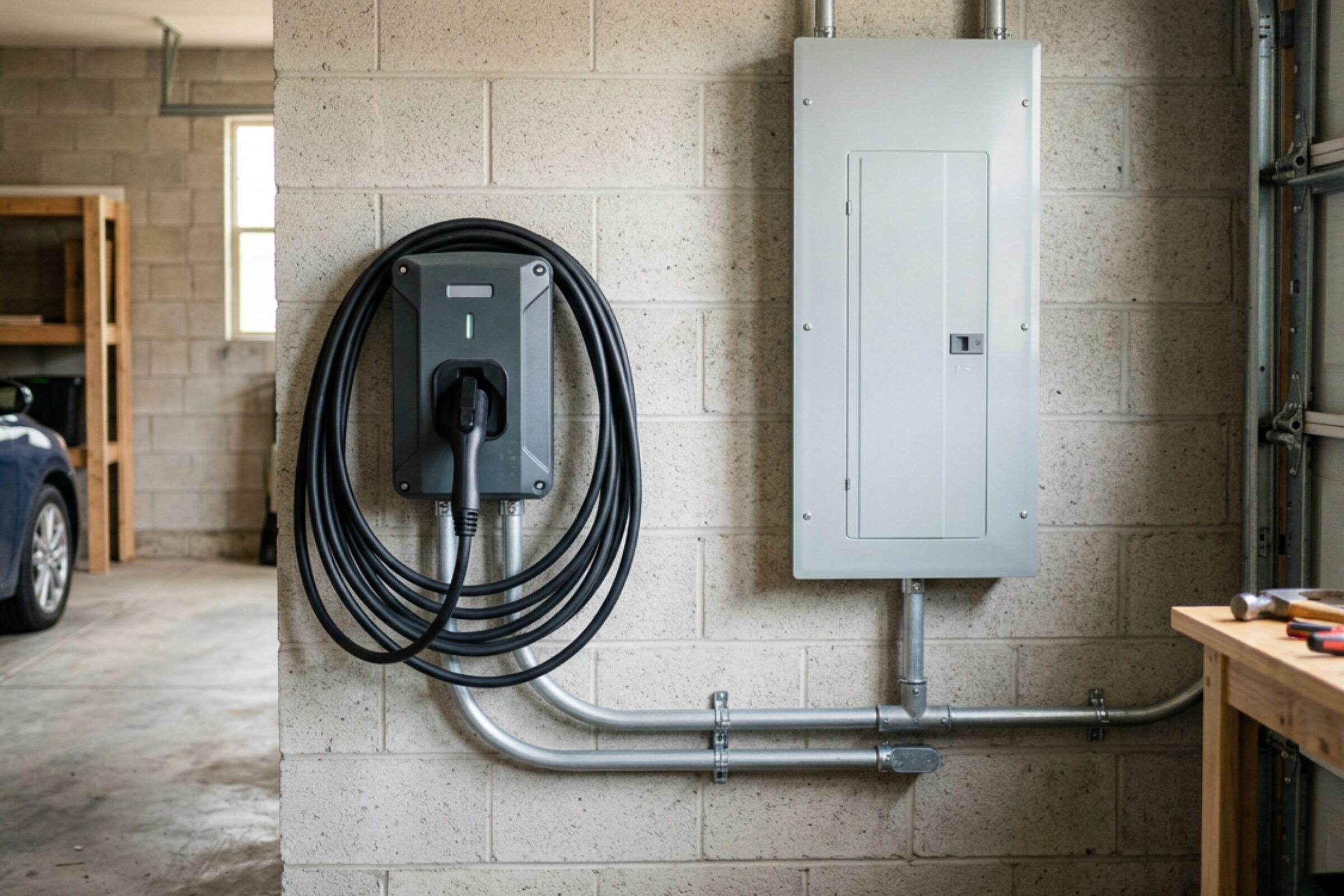
Some Level 2 chargers connect to a suitable receptacle. Others are hardwired.
Hardwiring removes the plug-and-receptacle connection and is often used for higher-current installations. Plug-in equipment can be convenient, but the receptacle, circuit, protection, and installation method must meet applicable requirements.
Charging is a continuous electrical load. As a common example, a charger configured for 32 amps generally requires a 40-amp circuit. The electrician must confirm the correct sizing and protection for the actual installation.
Choose equipment with recognized Canadian electrical safety certification.
Smart Features, Rates, and Rebates
Network-connected chargers can provide scheduling, energy tracking, and remote controls. Some also support utility-managed charging programs.
These functions can be useful, but check whether essential charging functions continue if Wi-Fi or a subscription becomes unavailable. A charger should fit your routine without creating unnecessary dependence on an app.
Time-of-day electricity rates may reduce costs for drivers who can charge overnight. Compare the full rate structure with your household usage, since savings depend on when all your electricity is consumed.
Managed-charging rewards are a separate consideration. Eligible programs may pay enrollment or participation incentives, but charger compatibility and participation conditions vary.
Verify Incentives Before Buying
British Columbia has had rebate programs for home chargers, EV energy management, multi-unit residential buildings, and workplaces. Funding availability, eligible equipment, application deadlines, and rebate amounts can change.
Do not build a project budget around an old rebate figure.
Before purchasing, confirm the current program rules through the relevant utility or government administrator. Check whether preapproval is required, whether the exact charger model qualifies, and which purchase and installation expenses are eligible.
Buy new equipment from a legitimate seller and retain invoices. Online listings deserve particular care because counterfeit or uncertified equipment can create safety and eligibility problems.
Shared Buildings Need a Broader Plan
A condo parking stall presents different questions from a detached-home driveway.
The building may need approval processes, a shared electrical-capacity assessment, billing arrangements, and infrastructure that can accommodate more drivers later. Network connectivity may also be required for reporting or cost allocation.
Commercial electrical planning for employee charging has similar concerns. Several moderately powered chargers with coordinated load sharing may serve users better than a few high-output units.
For shared properties, planning the electrical backbone early can prevent repeated work each time another vehicle arrives.
A Practical Way to Decide
Begin with your normal daily distance and overnight parking time. Then check the vehicle’s connector and maximum AC charging rate.
Have an electrician assess the existing service, suitable circuits, panel space, and actual household demand. Ask about lower-current charging and approved load management before assuming a service upgrade is unavoidable.
Finally, compare installation options and verify equipment certification, permit requirements, and current incentive eligibility before purchasing.
The right EV charging setup is the one that reliably replaces the energy you use while staying within the property’s electrical limits. Faster charging has value when you need it. For many households, dependable overnight charging is enough.